Archives For November 30, 1999

For my Masters and PhD I worked on the Sudbury Neutrino Observatory, where I worked on the water purification team and also the computer simulation of the detector. It was a great time and I learned a lot from my Supervisor John Simpson at the University of Guelph in Canada.

The papers below are SNO collaboration papers, in addition to papers in journals like NIM, where our lab published the details of our ultra low level radon counting experiments.


I maintain a list on Research Gate of my publications.


EPR effects have been shown in the lab to agree with QM to a high degree – even when the events are space like separated.

But what if the ‘instant – non communication’ – the wave collapse – happens instantly only in the preferred rest frame of the Universe (the one we are going through at about 670km/sec)

Then experiments like Aspects would show agreement with QM, but a much more finely tuned experiment might get some sort of non QM effect happening if the two measurements are done such that in the hypothesized rest frame B is before A.

So instead of merely looking for B to be outside the light cone of A, we look for the EPR collapse effect to continue (or not) by looking at the rest frame of the universe.

Perhaps even reanalysing the data from some EPR experiments that have already been done might show something!

I have been thinking about frame dragging and faster than light travel for a few days, and then about the fact that quantum collapse seems to take place ‘instantly’ (faster than light).

So then I read about the photon size for a 1MHz radio wave which is 300 metres – quite large.

So this huge wave has to refract as a wave and yet somehow instantly collapse into a very small area to be absorbed? Instantly? Insanity!

Wild thought: Frame dragging faster than light and gravitational shock waves to the rescue!

Answer: Collapse is a shockwave that causes frame dragging, allowing for ‘instant’ effects to happen (also EPR).

Frame dragging can in principle be used to travel faster than the speed of light. This is a known scientific fact that is thought to be non possible in practice due to all sorts of limitations. Science fiction of course loves it.

So a soliton forms and sweeps energy out of the wave and into the reception antenna.

If we could control this soliton collapse – we could perhaps harness it to perform faster than light communication and travel.

The soliton ‘shock wave’ is composed of gravity (as is light and everything else). It would have to have some very specific configuration.

Frame Dragging

Frame dragging occurs with linear effects too. My thought experiment on this is through a Mach – like view point. If you are inside at the middle of a very long pipe, which starts to accelerate, you will be dragged along. If the pipe stops at some velocity, you will approach that velocity eventually.

So space couples not to mass but to matter. If it just coupled to mass, you would not be able to tell if your neutron rope was moving or not. It couples instead to the actual bits of matter.


What about circularly polarized gravitational waves – timed so that the squished part is always in front and the expansion is behind the particle? So that’s 90 degrees from direction of travel of the waves – but perhaps they can be entrained as a soliton solution. Soliton


The Speed of Light

The speed of light limit is at this point a postulate of physics, which is necessary as:

  • Electromagnetic Radiation travels at c.
  • Maximum speed of particles is c. (Lorentz equation).
  • Relativistic QM – depends on c as a postulate.
  • Strong force.
  • more…

These are in the Standard Model disparate fields and laws. Why do they all share the same speed ‘c’? The only real answer right now is ‘because’. Hence the speed of light is a postulate.  In modern physics this fact is acknowledged by saying that its not the ‘speed of light’ but rather the ‘fundamental speed’.

Postulates are never a good thing. Much of our understanding of the physical world comes from explaining away what we thought were arbitrary rules using more fundamental principles.  We do need postulates, but its a good thing when we can lower the count. The Standard Model + QM have many tens of postulates (rules, particle masses, coupling constants, etc etc).

Now look again at a universe made of only GR. The speed of light becomes the speed of gravity – a ‘mere’ bulk propagation constant – the speed of Einstein’s Aether.

If one were to then build out other fields and physical effects (e.g. emergent quantum mechanics) using GR as a base, the speed of light is not needed as a postulate. It then becomes transparent as to why the speed of light is the same as the speed of gravity, and why the equations of relativistic QM are littered with the symbol ‘c’. Some ideas of how to build todays physics from GR are outlined in other posts on this site, but also see Brady and Anderon’s paper.

Lorentz Transformation

The behaviour of particles and clocks at velocity is dealt with using Lorentz transformations. These same transformations arise when looking at emergent phenomena such as Brady’s sonons travelling through an inviscid medium with a sound velocity. Thus Lorentz contraction can be thought of as arising from the bulk properties of the GR field.

Consequences

Removing the speed of light as a postulate would be a good thing, but are there any measurable consequences? In other words, if there is some truth to this theory is there any experiment that might be done to show that the speed of light is merely a bulk property of an all encompassing field that creates all matter, fields and forces?

Look at the speed of sound on Earth. This speed forms a barrier to objects moving faster than sound. But jets and asteroids can move faster than sound. So maybe analogously we can find a way to break the light speed barrier? Its not as simple as breaking the sound barrier though, as GR is an extremely strong field with a truly huge range of perfectly linear behaviour. To get an idea of its strength, consider that a mass of the Earth formed into a black hole is only about a cm in size, and so GR behaves linearly up to within a metre or so of that incredible field strength.  But experimenters have access to extremely accurate clocks, huge collision energies and lots of computational power.

Once its accepted that the the speed of light might not a postulate, experiments are possible. There are actually quite a few people already measuring the constancy of the speed of light.

Conclusion

The fact that the speed ‘c’ is ingrained in all of physics and that General Relativity has this speed built in at a fundamental level is a huge clue as to the underlying makeup of the world around us.

My take: Its all GR.

–Tom Andersen, July 1 2015


Would there be any consequences that we could measure?

http://physics.stackexchange.com/questions/178545/maximum-power-transmitted-using-general-relativity-waves-cf-schwinger-limit

For instance, there is an upper bound of the amount of EM energy that can be poured through a square mm of area – not predicted by Maxwell’s Eqn’s of course, as they are linear, but by quantum field effects. If we instead look at how gravitational energy we can pass through that same square mm, is it the same number of joules/sec? http://en.wikipedia.org/wiki/Schwinger_limit

Well there are a few problems with the Schwinger limit too:

"A single plane wave is insufficient to cause nonlinear effects, even in QED.[4] The basic reason for this is that a single plane wave of a given energy may always be viewed in a different reference frame, where it has less energy (the same is the case for a single photon)."

So according to QED, we can actually make a laser of any power – and as long as its in a vacuum, there are no non linear effects. Can that really be true?

The Schwinger limit is about 2.3 E33 Watts/metre^2.

I have calculated the limit of gravitational wave energy (which depends on frequency) to be

P (max gravity waves) = 3/(5pi)*c^3/G*w^2,


In Electromagnetism, QED says that the linearity of Maxwell’s equations comes to an end when field strengths approach the Schwinger limit. Its about 10^18 V/m.

What is the corresponding formula for gravitational waves. Since gravity is a non-linear theory, there should be a point where gravitational waves start to behave non linearly.

Here is my calculation, based on http://en.wikipedia.org/wiki/Gravitational_wave:

There is a formula there for the total power radiated by a two body system:
(1) P = 32/5*G^4/c^5*m^5/r^5 (for identical masses in orbit around each other)

Further down the same wiki page I see a formula for h, which has a max absolute value of (assuming h+ and standing at R = 2r away from the system, theta = 0):

(2) h = 1/2*G^2/c^4*2m^2/r^2

Things will be highly non linear at h = 1/2 (which is the value of h used in the diagram on the wikipedia page!). So lets set h = 1/2, and then substitute (2) into (1) to get the power as radiated by the whole system when h = 1/2 (use a lower value like h = 0.001 perhaps to be more reasonable, if you like). I am not trying to calculate where the chirp stops in a binary spin-down here, I’m looking for the maximum field strength of a gravitational wave.

I get for the maximum power from a compact source

(3) P = 64/5*c^3/4*m/r

That’s the total power radiated when h is well into the non linear region – you will never get more than this power out of a system using gravitational radiation.

The result depends on m/r , which makes sense as higher frequency waves with the same value of h carry more power.

Putting the result in terms of orbital frequency, w, we get (using newtonian orbit dynamics (http://voyager.egglescliffe.org.uk/physics/gravitation/binary/binary.html)

(4) Pmax = 16/5 c^3/G*w^2*r^2

That’s the max coming out of a region r across, we want watts per sq metre, so divide by the surface area of a sphere:

(5) Pmax/per sq meter = 3/(5*pi)*c^3/G*w^2

The maximum power that you can deliver at 10^14 Hz (light wave frequencies, so as to compare to the E&M QED Schwinger limit) is 10^65 watts/m^2 !

That’s a lot of power, dwarfing the Schwinger limit.

Is that about right? The max power scales as the square of the frequency, and is truly huge, reflecting how close to linear GR is over large parameter spaces.

w = frequency

So for gravitation, we have linear behavoir holds up until some fantastic power level:

http://www.wolframalpha.com/input/?i=c%5E3%2FG*%28%285*10%5E14%29%5E2%29%2Fsec%5E2

1e65 watts per sq metre at visible light frequencies is about the linear limit for gravitational waves at a frequency of 10^14 .

This means that gravity has ‘lots of headroom’ to create the phenomena of electromagnetism.


Perhaps one could dream up a super efficient way to generate ‘normal’ quadrupole gravitational radiation using some radio sources arranged in some way. Or a way to generate anti-gravity, etc.

GR certainly has a large enough range of linearity to power all of the EM we know today. Its also possible to generate monopole and spin 1 radiation from gravity, look up Brady’s papers on EM generation from simple compressible fluids, for instance.

Also do the joules/sec per square mm or whatever calc.

Also look at some other consequences in the dark recesses of the proton and electron (my models of them, or effects just based on size and field levels).  Would we start to get non-linear EM effects at what distance from the centre of an electron? Same for quarks?

http://en.wikipedia.org/wiki/Gravitational_wave


http://voyager.egglescliffe.org.uk/physics/gravitation/binary/binary.html

Ref http://www.jetp.ac.ru/cgi-bin/dn/e_038_04_0652.pdf

Yves Couder’s (and others) experiments with small (in the human sense) and absolutely huge (in the quantum sense)  silicon oil droplets and baths have proven to be a wonderful analog for quantum mechanics.

There are many researchers who think that these experiments show something much more – they hint at what the microscopic quantum world is really like. The quantum like effects occur when the driving force and frequency of the system are carefully tuned. When the conditions are right, the drops interact with their own waves – long after the waves have been emitted. Couder calls this behaviour the ‘high memory regime’ – its where all the quantum like behaviour emerges.

So the question becomes – what is the memory of a real quantum system? The answer to that question is surprisingly simple. Its infinite. Quantum states can entangle and ‘live’ forever. This fact is the foundation of Quantum Computing, the Many Worlds Theory and many other absurdities (Schrödinger’s cat…). Indeed the only point in QM where memory is not complete and infinite is at the point of measurement. But measurement is in the eye of beholder, and thus we need not worry about the measurement problem here. Or rather we will attempt to solve the measurement problem with a new hypothesis – that the memory of real quantum systems are limited, and that this limit is responsible for the collapse of the wave function.

This of course could kill or seriously limit the reach of quantum computing, and would provide a quick end to the Many Worlds Theory, and many many other consequences of quantum mechanics. Indeed Hilbert Space itself would lose its ‘reality’ – becoming nothing more than a mere mathematical trick for ‘memory intact’  (AKA pre-collapse) states.

What is the form of the memory? In Couder’s experiments its simply the range of an emitted wave in meters. Since his test trays are small, this means that the waves can bounce off the walls and interact with the emitter again.

We can look at such a system as a particle in a well. In Couder’s experiments you can see excited states decay after a time, and this time is increased as the memory of the system is increased.

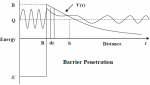
So if we look at the simplest alpha_emissionphysical analog of this – a particle in a well that can quantum tunnel out – we have  Alpha – emission. These particles are trapped in the nucleus, but sooner or later they tunnel out.

Thus tunnelling is a collapse of the wave function – these alpha particles leave fossil traces in rocks for instance, so they have been emitted in a very real sense.

Of course the pure QM follower will tell you that each emitted alpha is just another cat in a box - and that the entire history of the world hinges on you (or is that any smart person?) looking at the actual billion year old track - only then does the linear superposition of uncountable 10Millions of state vectors collapse. Kind of hilarious, but that is what a truly linear system will do to you if you push it!

What causes the emission? The wave function has presence inside and outside of the barrier, so it can ‘feel’ that there is a lower energy state out there waiting for it. In a real pilot wave sense the pilot wave extends into the region beyond the barrier. We have a series of waves inside a femto metre sphere or so, and they bounce around for a few years (or 1024) years, or 10-6 seconds.

So a large variation of lifetimes – yet the playground is almost the same size, its the energy levels that are different, but only by a small factor. The greater amount of the wave function that is outside the nucleus, the shorter half life.

What really happens? Is it that the particle keeps inside the nucleus, and as soon as it randomly happens to walk out it is released? In ‘real QM’ the wave function only gives a probability for finding the alpha outside the nucleus, so in some sense its ‘constantly’ out there. But in a realist theory the alpha has a real velocity inside and around the nucleus. This could perhaps be a real difference – perhaps if we postulate a fixed speed of the alpha on a random walk through the probability field, we can connect the lifetime to the percentage of the wave function that is outside the nucleus. See

Unpredictable Tunneling of a Classical Wave-Particle Association

So if a certain percentage of paths is outside, and the particle covers … do the calculation – random walk – step length is some distance much less than the nucleus size, speed v, then typical time to get out would be defined.  perhaps with the speed held constant, we can determine step length by looking at the size of the region of probability outside the nucleus, we can determine the speed/step length that is implied. Someone must have done this?

http://demonstrations.wolfram.com/GamowModelForAlphaDecayTheGeigerNuttallLaw/

So in the playtime circa 1900 flat spacetime where QM currently works, there are no non – local effects and QM makes sense. This is why most theorists like the quantization of gravitation program – it would bury the annoying real 4D version of spacetime underneath many levels of obscure mathematics.

The Aether

Einstein:

We may say that according to the general theory of relativity space is endowed with physical qualities; in this sense, therefore, there exists an aether. According to the general theory of relativity space without aether is unthinkable; for in such space there not only would be no propagation of light, but also no possibility of existence for standards of space and time (measuring-rods and clocks), nor therefore any space-time intervals in the physical sense. But this aether may not be thought of as endowed with the quality characteristic of ponderable media, as consisting of parts which may be tracked through time. The idea of motion may not be applied to it. [1]

Brady:

Brady, in the paper “The irrotational motion of a compressible inviscid fluid” hypothesizes something different – that the universe is made of a non – relativistic compressible fluid, and that this fluid generates General Relativity.

Einstein’s inertial medium behaves as a nonrelativistic barotropically compressible inviscid fluid.[2]

Although my model of the electron and quantum effects is very similar to Brady’s, I diverge with him on the essence of the aether. I hypothesize that Brady and Einstein’s ether are the same thing, so that instead of Brady’s concept of generating GR from aether, we instead start with Classical General Relativity (with ‘no matter’, so the stress tensor T = 0), and then  create Sonons as solutions of GR. The aether is that of Einstein’s GR.

Einstein’s Aether in Fluid Dynamics terms

Einstein’s aether is inviscid – which means it has no viscosity (rocks travelling through empty space experience no drag…). Is it compressible? Certainly – this is what constructs such as black holes are. Is it irrotational? – that is a not a property that we need to determine, since without viscosity, an irrotational flow will stay that way.

Truly Inviscid?

No. GR is non-linear, which makes the inviscid property only an approximation – it’s a good approximation, though! Waves generated on an ocean or an oil puddle in a lab travel a limited distance, while the waves of GR can easily travel the universe. But they don’t travel ‘forever’.

Consider now the construction of a Brady like sonon out of pure GR. We follow Brady’s paper until section 1.1, where he states:

When an ordinary vortex is curved into a smoke ring, this force is balanced by Magnus forces (like the lift of an aircraft wing) as the structure moves forward through the fluid [10]. However a sonon cannot experience Magnus forces because it is irrotational, and consequently its radius will shrink, causing the amplitude A in (5) to grow due to the conservation of fluid energy. Nonlinear effects will halt the shrinking before A reaches about 1 since the density cannot become negative.[3] 

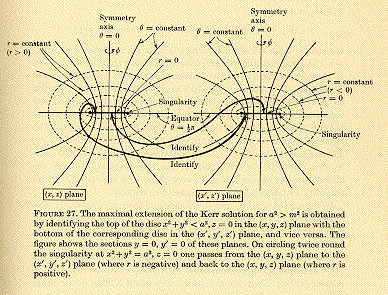
Intriguing. Look now at a completely classical general relativistic object – a spinning  Kerr solution. We have a tightly spinning GR object that can shrink no further.  Since we are trying to model an electron here, we use the standard black hole values (for an electron model this is a ‘naked’ a > m Kerr solution [6])

Brady’s sonons interact with the surrounding aether – how would that work in GR? We are after all taught that all GR objects like black holes have no hair. But of course they can have hair, its just that it will not last long. That’s the point here. Sonons can and will stop interacting if the background incoming waves die down below a certain point. But above a certain point black holes become perturbed, and things like ‘superradiance’  as Teukolsky and others discovered come into play.

Indeed, as long as there are incoming waves, it seems that objects made of GR are highly reactive, and not boring at all.[4][5]

So pure GR has at least the ability to interact in interesting ways, but are the numbers there? What frequencies do we need for Brady like Sonons constructed from GR (I’ll call them geons from now on) to get to the point where there are electromagnetic strength interactions are taking place?

Bradys interactions occur with mass transfer – the compressible fluid carries away mass to and from each Sonon in a repeating manner. Not a problem for any GR ‘blob – geon’.  If they interact, then energy must be flowing in and out – that’s the definition of interaction.

An Electron Model

A previous post here – An Electron Model from Gravitational Pilot Waves  outlines the process.

We take a small region of space (e.g.  containing a Kerr solution) and assume that this region of space is exchanging gravitational energy with its surroundings.  Call it an geon-electron.

Assuming that the exchange takes place in a periodic fashion, the mass of this geon-electron (energy contained inside of the small region of space) is given as

me(t) = me*((1 – f) + f*sin(vt))

where v is some frequency, and f is the proportion of mass that is varying, so f is from 0 –> 1.

This varying mass will give rise to changes in the gravitational potential outside the region.  But gravitational effects do not depend on the potential, rather they depend on the rate of change of the potential over spacetime intervals.   So it’s not the potential from this tiny mass that is relevant, it is the time derivative of the potential that matters.

Potential = -G*me(t)/r

Look at the time derivative of the potential

dP/dt = -G*me*f*v*cos(vt)/r

This gradient is what one can think of as the force of gravity. This force rises linearly with the frequency of the mass oscillation.

The EM force is some 10^40 times that of gravity, so we just need to use this factor to figure out an order of magnitude estimate of the frequency of this geon mass exchange rate.

This is detailed in the ‘Coulomb Attraction’ section of an earlier post.

Using de Broglie’s frequency – he considered the Compton value of 1.2356×10²⁰ Hz as the rest frequency of the internal clock of the electron, one arrives at an electron model with these properties:

  • Entirely constructed from classical General Relativity
  • Frequency of mass exchange is the Compton frequency
  • Electromagnetic effects are a result of GR phenomenology
  • Quantum effects such as orbitals and energy levels are a natural result of these geons interacting with their own waves, so QM emerges as a phenomenon too.


Einstein’s Vision:

“I published the paper on the relativistic dynamics of the singular point indeed a long time ago. But the dynamical case still has not been taken care of correctly. I have now come to the point where I believe that results emerge here that deviate from the classical laws of motion. The method has also become clear and certain. If only I would calculate better! . . . It would be wonderful if the accustomed differential equations would lead to quantum mechanics; and I do not regard it as being at all out of the question” (Ref: Miller, 62 years of uncertainty)

The State of Physics today ————————– Obviously a sea change in fundamental physics would be needed to allow for anything like these ideas to be considered. In fact its not that the ideas here might be correct – but rather that Brady and others who toil on actual progress in physics are sidelined by the current ‘complexity is king’ clique that is the physics community today. The physics community is more than it ever has been in the past, a tightly knit clique. This may be the fault of the internet and the lock in group think that instant communication can provide. This clique gives rise to ideas like ‘quantum mechanics is right‘ and other absurdities, such as the millions of hours spent on String Theory, when it’s ‘not even wrong‘.

Tests and Simulations

Given the entrenched frown on the subject of alternative bases for the underpinnings of our physical world, we need to look for experimental evidence to support these kinds of theories.

The work of Yves Couder and his lab in one kind of essential experiment. They have shown conclusively that quantum like behaviour can emerge from classical systems.

Another path – one that in my opinion has been somewhat neglected in this field is that of numerical techniques.

Here I outline some steps that might be taken to construct a GR based model of an electron. Excuse the more colloquial manner, I am making notes for a future project here!

Numerical Plans

There are only about 22 Compton wavelengths within the Bohr radius. So if one goes to a 100 Compton wavelength simulation zone, with 1000 grid points on a side, thats 1e9 grid points, and each point needs only four 8 byte doubles, so 32 bytes, so 32 GB.

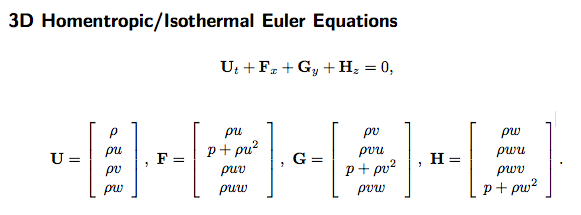
The equations to solve on this simple grid are those of fluid dynamics: Compressible Isothermal Inviscid  Euler equations.  : As from I do like CFD.

Screen Shot 2014-07-14 at 10.08.23 PM


With a 32GB data set, 1e9 data points, and about 1000 computer FLOPs per visit, we have 1e12 FLOPs per time step, and an algorithm that gets 10GFlops, I get about a minute per time step.  Each time step needs to cover about 1/100th of the Compton time, or about 1e-22 secs, and we need to let light cross the atom (3e-19 secs) hundred times to get things to converge, or about 3e-17secs, so 300,000 time steps. (Better speed up the algorithm! Should be easy to get 20GFlops over 8 processors, and perhaps cut Flops/grid point down, which could mean a day or so on a 8 core Intel).

Computer Model:

Note on the Fine Structure Constant (useful in a numerical model)

The quantity  was introduced into physics by A. Sommerfeld in 1916 and in the past has often been referred to as the Sommerfeld fine-structure constant. In order to explain the observed splitting or fine structure of the energy levels of the hydrogen atom, Sommerfeld extended the Bohr theory to include elliptical orbits and the relativistic dependence of mass on velocity. The quantity , which is equal to the ratio v1/c where v1 is the velocity of the electron in the first circular Bohr orbit and cis the speed of light in vacuum, appeared naturally in Sommerfeld’s analysis and determined the size of the splitting or fine-structure of the hydrogenic spectral lines. [*]
See also the Wikipedia physical interpretation section.


Cosmic Censorship:

Weak or strong, the cosmic censorship conjecture states that naked singularities can’t be seen, otherwise everything will break down, it would be really bad and worst of all theorists would be confused.

Hawking and Ellis, in The LargeScale Structure of Space-Time (Cambridge 1973)

Hawking and Ellis, in The LargeScale Structure of Space-Time (Cambridge 1973)

But it turns out that singularities very likely don’t actually exist in a real universe governed by GR. Any lumpy, non symmetric space time can have all the spinning black holes it wants – at any angular momentum, even with   a > m (angular momentum greater than the mass in suitable units), as the Kerr solution + bumps (bumps are incoming GR full bandwidth noise), will have no paths leading to any singularity! So the curtain can be lifted, the horizon is not needed to protect us.

Cosmic Serendipity Conjecture:

In any sufficiently complex solution of GR, there exists no singularities. I am not talking about naked singularities here, I mean any and all singularities.

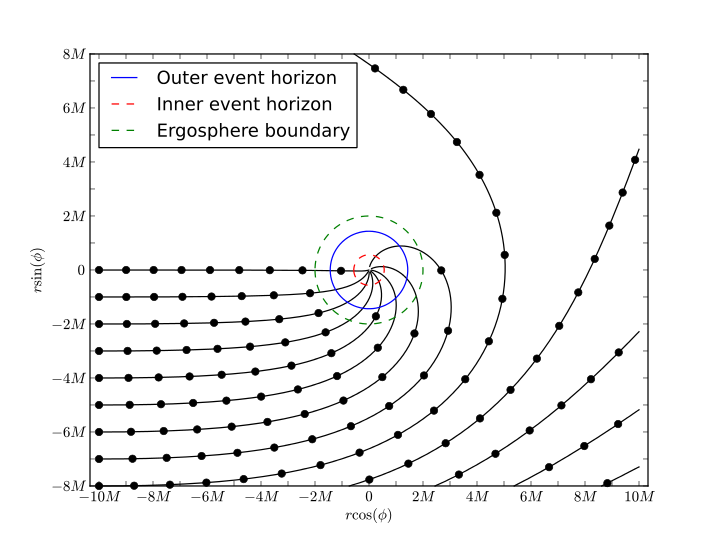
The complex nature of the interaction of GR 720px-Particle_trajectories_around_a_clockwise_rotating_black_hole.svgat the tiny scales where the singularity would start to form stop that very formation. In other words, the singularity fails to form as the infalling energy always has some angular momentum in a random direction, and ruins the formation of a singularity.

In all likelihood actual physical spinning black holes in a turbulent environment (normal space) will have no singularity.

I will let Brandon Carter speak now:

“Thus we reach the conclusion that at timeline or null geodesic or orbit cannot reach the singularity under any circumstances except in the case where it is confined to the equator, cos() = 0…..Thus as symmetry is progressively reduced, starting from the Schwarchild solution, the extent of the class of geodesics reaching the singularity is steadily reduced likewise, … which suggests that after further reduction in symmetry, incomplete geodesics may cease to exist altogether”

Kerr Fields, Brandon Carter 1968.

Not cosmic censorship, but almost the opposite – singularities can’t exist in an GR universe (one with bumps) because there are no paths to them.

We have all been taught that singularities form quickly – that when a non – spherical mass is collapsing, GR quickly smooths the collapse, generating a singularity, neatly behind a horizon. Of course that notion is correct, but what it fails to take into account is that in a real situation, there is always more in falling energy, and that new infalling energy messes up the formation of the singularity.

While there may be solutions to Einstein’s equations that show a singularity (naked or not), these solutions are unphysical, in that the real universe is bumpy and lumpy. So while the equations hold ‘far’ away from the singularity, the detailed Gravity in the high curvature region keeps it just that – high curvature as opposed to a singularity.

The papers of A.Burinskii  come to mind, e.g.:

Kerr Geometry as Space-Time Structure of the Dirac Electron

Conclusion

I am willing to bet that this conjecture is experimentally sound, in that there are no experiments that have been done to refute it. (that’s a joke I think).

On the theory side, one would have to prove that a singularity is stable against perturbation by incoming energy, which from my viewpoint seems unlikely, as the forming singularity would have diverging fields and diverging response to incoming energy, which would blow it apart. Like waves in the ocean that converge on a rocky point.

http://physics.stackexchange.com/questions/193340/does-general-relativity-entail-singularities-if-theres-a-positive-cosmological

pic15

–Tom

Koide and Compton

The Koide formula is a remarkable equation relating the masses of the 3 leptons. When it was first written down, it did not in fact predict the mass of the tau to within experimental error. Turns out though that the experiments were wrong. A decade or two passed: it turns out that the Koide formula is extremely accurate.

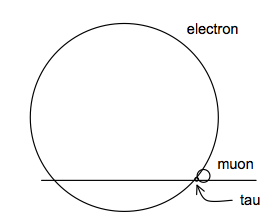
The Koide formula has been compared to Descartes theory of circles: One can see that the two relationships bear a resemblance. Jerzy Kocik, in his paper called “The Koide Lepton Mass Formula and Geometry of Circles” uses this correspondence to determine that the Koide formula looks like a generalization of Descartes Circle equation – with a characteristic angle of about 48 degrees.

Kocik's generalization of Descartes' circle formula

If one uses this formula, then the radius of the electron is actually the biggest, and tau smallest, (with a further particle having no or almost no mass…-  ν  ?).

Large electron a result of this. We have Radius proportional to 1/mass.

So are there any physical models that work well with the lightweight electron being large?

The Koide Lepton Mass Formula and Geometry of Circles

Koide – 2012 geometry paper – uses inverse mass as Descartes curvatures, so electron bigger than muon.

Gravity vs. Quantum theory: Is electron really pointlike?

Alexander Burinskii  – posits these same radii for the electron, muon and tau, using the Kerr Neumann formula r = J/m = hbar/2m. Note that I would use only the Kerr formula (same answer for large a)

Implies huge electron, but as Burinski points out, this might not be the size we see when accelerated, etc.

So if the Koide formula is real, then it describes some relationship between the areas (using the geometry paper) where they overlap at some 48 degree angle (look at diagrams).

The naked kerr solution describes a wormhole like situation, so we could get the mass oscillation that I am looking for.

Also – is a kerr solution with a so high really a naked singularity. The ring would look like a straight line (use cylindrical coordinates) – like a line of sharwshild solutions moving in space – would this make an horizon again? (I am thinking of a tubular horizon…)

Click to access 0701006.pdf

1112.0225.pdf (burininski)

Compton Frequency Mass Exchange…

de Broglie

His original conception, his “double-solution theory” (de Broglie 1956), involved two waves, a real pilot wave centered on the particle and the statistical wave predicted by standard quantum theory. He asserted that quantum mechanics was intrinsically relativistic and proposed that the pilot wave originates in internal particle oscillations at the Compton frequency , ωc =mc2/h at which rest mass energy is exchanged with wave energy. He proposed that the guiding wave field evolves according to the Klein-Gordon equation and consists of a monochromatic wave field in the particle’s frame...[Bush 2015]

Click to access aflb124p001.pdf


Abstract

An electron model is presented where charge, electromagnetic and quantum effects are generated from pilot wave phenomena. The pilot waves are constructed from nothing more than gravitational effects. First the general model of the electron is proposed. Then the physical consequences are laid out, showing that this model can generate large electron – electron forces, which are then identified with the Coulomb force. Further, quantum mechanical effects are shown to emerge from this model.

Electron model:

An electron is modelled as a small region of space which has a varying mass. The origin of this varying mass will not be discussed here. The mass of the electron is given as

me(t) = me*((1 – f) + f*sin(vt))

where v is some frequency, and f is the proportion of mass that is varying, so f is from 0 –> 1

This varying mass will give rise to very large changes in gravitational potential – essentially the time derivative of the mass will be a potential that has a slope proportional to the frequency. Assume that this frequency is very high, and you can see potential for some huge effects to come into play, as compared with the tiny gravitational field of a normal mass the size of an electron.

Throughout this paper only classical physics will be used, and on top of that, the only field used will be that of gravity (GR).

I said that the mechanism for this time – varying mass will not be discussed, but here are two possibilities. One possibility is that electrons are some sort of wormhole, with some portion of their mass disappearing into and out  of this wormhole, like some mass bouncing between two open throats. The other more simple way this could happen is if the electron was simply losing mass off to infinity – and getting it back – in a periodic fashion.

Coulomb Attraction

So how would two of these time varying mass electrons interact?

I will use the 2014 paper “Why bouncing droplets are a pretty good model of quantum mechanics“ as a starting point. 

Please open up that paper and have a look:

In section 4.3 – 4.4, the authors use analogy of two vacuum cleaners(!) to come up with a mechanism for an “inverse square force of attraction between the nozzles”.

Screen Shot 2014-05-17 at 11.48.22 AM

Where ρ is the density of air and Q is the volume of air flow at each nozzle. I will use this train of thought to come up with a similar inverse square relation for my electron model.

In the equation above, ρ*Q gives the mass intake of one nozzle. In my model ρ*Q is thus the same as time rate of change of the mass of the electron, which averages out to f*me*ν, where

f = fraction of electron mass that is varying (f = 1 – me(min)/me)),

me == rest mass of electron,

and

ν = frequncy (greek nu).

So we have f*me*ν == ρQ, substituting into (8) from Brady and Anderson, we get

dp/dt = f*me*ν/(4πr^2)*Q

Where Q is still some volume flow, in m^3/sec. What, though is the volume flow for an electron – its not sucking up the surrounding air! One possibility is to model Q for my electron model as a spherical surface at some ‘electron radius’, with a speed of light as the velocity. So we have Q = 4πre^2*c and we get the force equation:

dp/dt = f*me*ν*(4πre^2*c)/(4πr^2)

This is the force on an electron nearby another electron at distance r in the model.

This should equal the Coulomb force law: (ke is the coulomb constant)

f*me*ν*(re^2*c)/(r^2) = ke*q*q/r^2

f*me*ν*(re^2*c) = ke*q*q

Now the fraction f, the frequency ν and the re are all unknowns. But lets use the classical electron radius for re, and a fraction f equal to the fine structure constant. Then we get solving numerically for ν the frequency… which is about 1000 times the Compton frequency. (So close to it in some ways)

ν = 1.5×10^25 Hz 

There are of course other options, as the effective radius of this electron is not known and also the mass fraction is unknown. So this result is more for scale’s sake than anything. Still I will use these numbers for the rest of this paper.

Also interesting is to derive the value of the coulomb force between electrons – simply calculate (leave f alone for now),

f*me*ν*(re^2*c)

This gets to about a factor of 1000 or so away from the correct answer for ke*q*q. But not bad considering that I present no reason why to choose the Compton values for radius and frequency, other than a first jab in the dark.

In section 4.5 – 4.10 the authors show how these pulsating bubbles follow Maxwell’s equations to a good approximation. In the model of the electron presented here, that approximation will be orders of magnitude better across a very large parameter space, as the GR field is much better behaved than bubbles in water, to put it mildly.

Its also easy to see that the resulting model is fully compatible with relativity and GR. Its after all made entirely out of gravity.

Quantum Mechanical Behaviour

The electrons modelled here, which only contain a varying mass, can produce electrical effects that exactly match that of the electric field. As the Brady and Anderson paper continues in part 5, so will we here.

In actual fact, since these electrons have been modelled using the same sort of pilot wave phenomena as Brady and Anderson use, there is not much further to do. QM behaviour erupts from these electron models if you follow sections 5, 6 and 7.

Pilot wave behaviour is outlined in the Brady and Anderson paper.

Conclusion

Electrons made with this model exhibit all the expected forces of electromagnetism, all without introducing electric fields at all. Electrical behaviour is then seen as a phenomena of Gravity, rather than its own field.

These electrons also behave according to the laws of QM, all by generating QM effects using pilot wave mechanics.

From the Brady and Anderson conclusion:

“These results explain why droplets undergo single-slit and double-slit diffraction, tunnelling, Anderson localisation, and other behaviour normally associated with quantum mechanical systems. We make testable predictions for the behaviour of droplets near boundary intrusions, and for an analogue of polarised light.”

This I believe shows a possible way to unify Electro Magnetism, General Relativity, and Quantum Mechanics.

Appendix

There would be much work to do to turn this into a proper theory, with some things needed:

1) What happens with multiple electrons in the same region? A: I think that the linearity of GR in this range assures that the results are the same as EM. It would show a path to finding the limits of EM in areas of high energy, etc.

2) How do protons/quarks work? A: It would seem that quarks might be entities with more complicated ways of breathing mass in and out. This is something that is apparent from their larger actual size, which approaches the maximum size allowed to take part in the geometrical pilot wave, which may run at the compton frequency.

3) Why is charge quantized? A: To me, it seems that the answer to this may be that electrons have quantized charge and protons/quarks are using feedback to keep to the same charge. What about electrons, why are they all the same? I think that’s a puzzle for another day, but perhaps a wormhole model of the electron could be made where the frequency and magnitude of the varying mass would be set from GR considerations.

I don’t expect this model to be instantly accurate, or to answer all questions right away, but the draw to unify EM, QM and Gravity is strong. Any leads should be followed up.

See also
 Oza, Harris, Rosales & Bush (2014)Pilot-wave dynamics in a rotating frame
MIT site: John W.M. Bush
Is quantum mechanics just a special case of classical mechanics?
Monopole GR waves
Other posts on this site as well..

–Tom Andersen

May 17,  2014

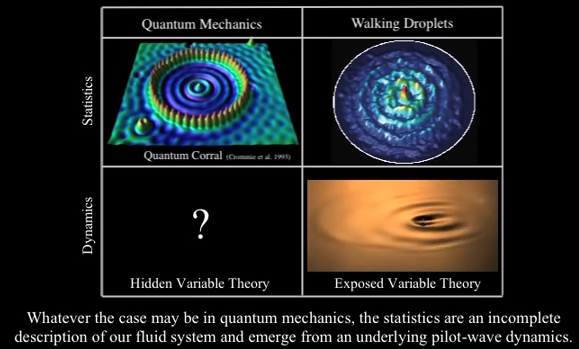
I start with a screen grab from the video below. Yves Couder and friends are clearly looking at hidden variable theories:

Screen Shot 2014-03-10 at 8.40.20 AM

Screen Shot 2014-03-09 at 6.46.17 PM

Here is a 3 minute movie with the above slide:

The pilot-wave dynamics of walking droplets

Here is a paper about eigenstates, etc… Self-organization into quantized eigenstates of a classical wave driven particle  (Stéphane Perrard1, Matthieu Labousse, Marc Miskin, Emmanuel Fort, and Yves Couder).

Compare that with my hastily written post.

See also (pointed out by  Warren Huelsnitz) :

 “Why bouncing droplets are a pretty good model of quantum mechanics

Yves Couder . Explains Wave/Particle Duality via Silicon Drop

“Couder could not believe what he was seeing”.

Here it was sort of a eureka moment at home on a Sunday afternoon.

Here is a link to the whole show.(45 mins)

https://www.youtube.com/watch?v=KByhu3HKy5s

Valentini:

Valentini (along with me) thinks that QM is wrong, in that its not the ‘final layer’. His de Broglie arguments are powerful and hit close to home for me. I have read most of David Bohm’s papers and books since discovering him as a 4th year undergrad back in the 80s. Bohm’s ideas launched mine. Note that much of physics is built on the assumption that with QM somehow ‘this time its different’ – that any future theory will need to be QM compliant or it is wrong. As if QM was somehow as certain as the (mathematical and hence solid) 2nd Law or something. This leaves no room for argument or dissent. Perfect conditions for a paradigm change!

http://www.perimeterinstitute.ca/search/node/valentini

EG:

This is the presentation that outlines things as he sees them. I see things that way too, although I am of the opinion that the pilot waves are GR ripples.

http://streamer.perimeterinstitute.ca/Flash/3f521d41-f0a9-4e47-a8c7-e1fd3a4c63c8/viewer.html

Is Quantum Mechanics Tried, True, wildly Successful, and Wrong?

Quantum Theory at the Crossroads
Reconsidering the 1927 Solvay Conference

A relaxing read:

Not even wrong. Why does nobody like pilot-wave theory?

“De Broglie’s law of motion for particles is very simple. At any time, the momentum is perpendicular to the wave crests (or lines of constant phase), and is proportionally larger if the wave crests are closer together. Mathematically, the momentum of a particle is given by the gradient (with respect to that particle’s co-ordinates) of the phase of the total wavefunction. This is a law of motion for velocity, quite unlike Newton’s law of motion for acceleration. “

Antony Valentini, Beyond the Quantum

If QM runs as wiggles in GR, we have a possible way to get collapse, and have a linear QM theory that breaks down over long times or with too many signals in one place.

In other words:

Each QM state vector is represented NOT only as a vector in a Hibert Space, but are really ‘real’  arrangements of (usually small scale) GR waves.

Since GR waves behave linearly over a large range of frequencies and amplitudes, these waves do not interact, and can be represented well as they are now in QM – by a Hilbert Space.

Collapse occurs when this linearity is compromised.

Thus there is a limit to entanglement and Quantum computing. The collapse of the wave function is a physical happening independent of observers. It occurs when these waves self – interact.

Indeed – with a theory where the QM states can only interact in a linear fashion, we have absurdities such as infinite computing power combined with massive Hilbert Spaces.

This should be quantifiable. In other words the collapse can be simulated on a computer system without Bohr like handwaving or the Many World’s trillions of universes per second per cubic cm coming into existence to avoid a true collapse (ok I know its more than trillions per second…).

To estimate the conditions for collapse: Take the likely amplitude of a single quantum wave (by looking at this mass – difference theory that I have for instance) and then see how many can pile into the same place before non-linear interference occurs – which would start a collapse. So collapse occurs when a simple isolated system interferes with a system with many more moving parts – an observation.

Entanglement/EPR/Bell outside the light cone is handled by non-local topology “worm – holes” in GR.

-Tom

How to make Dark Matter

October 20, 2013 — 2 Comments

I don’t divulge the recipe until later, lets start with the most undark matter we can find – CERNs protons.

CERN has proton – antiproton collisions going on at 7 TeV. There are collisions that generate up to a few TeV of photons.

Lets look at that from a viewpoint of classical physics, with some General Relativity added in the right place.

We have a few TeV of photons, these are generated in an extremely short period of time. We have two protons approaching and hitting (basically head on to get 2TeV of gammas). They are travelling at c. So that’s an interaction time of 2fm/3e8 m/s – 1.5 e-24 seconds.

So what happens gravitationally?

I have recently read a paper Monopole gravitational waves from relativistic fireballs driving gamma-ray bursts by Kutshera (http://arxiv.org/abs/astro-ph/0309448) that talks about this effect for, well exploding stars.

We have in a small area a mass of 7 TeV, of which about half leaves via gammas, the rest is in ‘slower’ particles like those higgs bosons, etc. This drop in mass results in a monopole gravitational wave. How big:

The force of Gravity is usually determined by the masses of the objects involved. But gravity is a local phenomenon (Einstein’s vision, not Newtons), and the field is actually a gradient of the potential.

So we have a potential change from 7 TeV to 5 TeV as seen by an observer near the collision as 2 TeV of gammas go whizzing by in a time span of 10-24 secs. Lets take the observer to be just outside the interaction area, say 10 fm away.

The gradient of the potential changes as the mass changes, which means its time dependent. We need the gradient.

Look at the Gravitational potential  of the observer before and after the wave passes.

Before G(7 TeV)/10fm and after we have G(5 TeV)/10fm. So that’s an potential difference of G(2TeV)/10fm acting over a time of 1e-24 seconds, which means that we have a gradient of (some math. )SI units! Observer is a proton 10fm away,

I get 8.1×10⁻²⁰ Watts – i.e. the observer proton sees its energy rise at a rate of 10-19 watts for 1e-24 seconds, it gets a boost in the away from the interaction, which raises its energy by a mere  5e-25eV.

Not much. But what I think is missing is that this sort of effect has to be looked at on a much smaller scale, and repeating, in that this monopole gravitational energy is coming in – then bouncing back out. The proton is thus an engine to this coherently at 1e40Hz or more, which makes other protons/electrons feel a force (they are bouncing this gravitational monopole radiation back and forth too) of the same size as the coulomb force. So this is the coloumb force. Electromagnetism as a phenomena of General Relativity. If you re-do the math with 10-47 or so seconds as the period then you start to see coulomb level forces at play. (Taking away accelerator energies ‘only’ adds a few zeros to the huge frequency requirement for mass exchange.)

The coloumb force rides above this – its a meta field ontop of this gravitationally built monopole system.

I think that electrons do this in a native, compact manner, likely using topology, while protons employ a complicated-ish ‘engine’ built of springs and struts made of GR that produce the same force as an electron. The strength of this force is determined by a feedback mechanism to balance that of the electrons.

Could dark matter be unlit(inactive/relaxed) protons? In other words protons that are not near an electron, and thus stop vibrating and being a charged particle. No near electron means no feedback means no charge. So perhaps looking for dark matter using a dense matter system like a block of germanium is bound to fail. We need to look using some sort of empty space experiment that gets to the vacuum conditions of interstellar (as we know dark matter exist on an interstellar scale).

An experiment might be to create a very hard vacuum starting with a hydrogen plasma, then as you pump down, look for some sort of indication that the charge of the remaining protons and electrons in the gas has gone down. You might look at the response of the p/e left in the chamber to photons – there will be less scattering as you pump down, but if the scattering falls off a cliff faster than your pumping rate you have made dark matter.

What is the distance at which this effect might happen at? In other words how far apart do electrons and protons have to be before the charge effect starts to stall? I am not talking about the range of photons – that’s infinite, but about the range of this effect – where will protons start to lose the signal from electrons, and calm down? 1m, 1micron? What is the density of gas in quiet parts of the galaxy? Intergalactic space is 1 atom/m3, I would say 1e6x this level is likely for some wastelands in the milky way. (we need dark matter in the milky way to get our velocity curves right!) So that’s 1 per cm3.

What’s the best vacuum you can make?

Ultra-high vacuum chambers, common in chemistry, physics, and engineering, operate below one trillionth (10−12) of atmospheric pressure (100 nPa), and can reach around 100 particles/cm

That’s about the right density. So has anyone ever measured laser scattering in such a chamber as a function of pressure? Corrected for pressure, we would get a horizontal line in a suitable graph. Boring stuff, it would seem, so likely not measured. The mean free path is 40km in these chambers.

Some problems solved by this ‘dark matter is matter gone dark’ hypothesis:

1) Early universe. It has been determined that the early universe must have had a mass that was much larger than the observed mass today. This is solved with dark matter, but that dark matter would have had to take part in things. If it were instead all just regular matter, there is no problem.

2) Early universe clumpiness: Its been really hard to come up with galaxies born so quickly. Yet they can be seen with telescopes. With all the matter in the early universe taking part, clumps are easier to make.

3) The lack of dark matter peaks at galactic cores. This one stumps the experts – physicists were sure that dark matter would accumulate at galactic cores, but it does not. If you have matter lighting up as it moves close to the core, then the radiation given off by this newly lit matter would keep things expanded, furthermore it is seen at the core, and so does not count as being dark. (http://www.cfa.harvard.edu/news/2011-29)

Early universe CMB

This is the way things are thought to work.

If all the matter was lit, then the He4/Li levels would be not what is observed. ==> Some kind of non interacting matter was needed.

The CMB is too smooth. Dark matter is needed to make galaxies:

Dark matter condenses at early epoch and forms potential wells, the baryonic matter flows into these wells and forms galaxies (White & Rees 1978). (Ref: http://ned.ipac.caltech.edu/level5/Sept09/Einasto/Einasto4.html)

Can’t be done, it would seem, since gravity is spin 2.

Well, electromagnetism is spin 1, but we have tech gadgets and a billion transistors on one chip.

So can one construct a machine that behaves like a dipole?

Take a canonical dipole. Two radio antennas, both vertical, one transmitting, the other receiving. The question then is, can we make a mass (or more likely a Rube Goldberg system of masses) bob up and down by the action of another mass-system moving at some distance away? if we can, then we have constructed a ‘spin one’ field from gravity, in much the same way that one can build something that is more than its parts.

The underlying field would of course be spin 2, but the field interpreted from the motions of our mass systems would look like a covariant, fully geometric compliant spin 1 field. It would in fact be a spin 1 covariant field.

Contraptions and questions come to mind right away. How do normal gravitational waves radiate as the eccentricity of an orbit approaches 1? What about a similar structure but with say a small particle orbiting a slender rod along the long axis. Not looking for stable orbits here at all. Just a mechanism to transfer a dipole motion across empty space to another construction of masses.

It seems more than possible that such an arrangement exists.


I read this paper today like a breath of air.

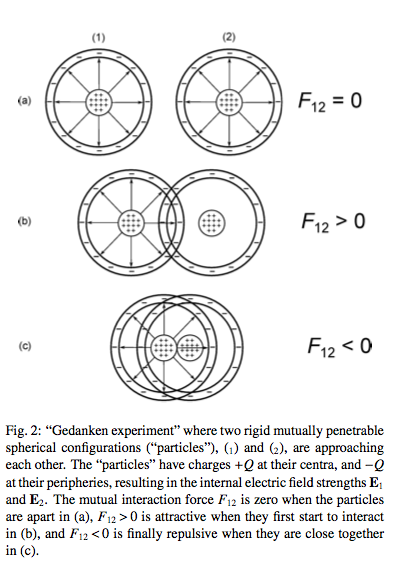
What if the electron is not a single negative charge, but rather an onion

like arrangement of charge, with an excess of 1 unit negative?

From Intrinsic Charges and the Strong Force by Bo Lehnert

Same for the neutron and proton (instead of 1/3 charged quarks).

Have a look at the image on the right. We see a ‘strong’ force holding these particles apart.

Could this be an actual model for real particles? I don’t think that the author of the paper intends for this model to be taken literally, but it certainly has some obviously interesting properties. Intrinsic Charges and the Strong Force.


The title about says it.

I have been thinking and reading a little about the electromagnetic potential and it gauge invariance lately. In simple, but absolutely correct terms, you can think of Gauge Invariance like this:

Electrons only respond to the slope of the voltage potential, and not the absolute value. So if you take any circuit, experiment, etc, planet, etc and add a million volts everywhere, no one will be able to tell, except people who look in from outside the circuit or planet.

This fact led physicists to renounce the potential as something real, and instead pronounce it as only a mathematical tool, useful for getting the field, which is the ‘real thing’. So in other words, ‘Voltage is not real’. Sure feels real to me when I get a shock from static or touching the wrong wire! But physics says its the potential difference that matters, and not the potential iteself. Point taken.

Then along comes the Aharonov-Bohm Effect (David Bohm is one of my heroes in physics). It describes an experiment where electrons can detect a change in the potential – where the changes result in no fields. In other words it seems that electrons can see this potential. To me, this is a sign that this potential is real. To others of course, its not.

Richard Feynman seemed to think more along the lines of the ‘potential is real’ camp.

So if its real, what gauge did nature choose? In other words what is the voltage of the universe? I of course don’t know, but if we assume that there is some real fixed gauge, then what could be the consequences?

1) No consequences for local experiments, etc.

2) Perhaps there are things on a larger scale that do arise from this permeating ‘potential’ everywhere. Could this potential (i.e. voltage) be real in the sense that it is made out of something? That is the crux. Its certainly not made of photons, like the electric field. My thinking of course is that it is made of gravity – standing wave patterns in space that make it possible for these varying mass electrons to  communicate (feel force) from other electrons and particles operating at the same (super high 10^50Hz) frequencies.

Could this potential, if its real, be Dark Energy?


— Tom Andersen


See also

http://arxiv.org/abs/1208.3224

http://arxiv.org/abs/0905.2589

Ref:

Feynman, R. The Feynman Lectures on Physics 2. pp. 15–5. “knowledge of the classical electromagnetic field acting locally on a particle is not sufficient to predict its quantum-mechanical behavior. and …is the vector potential a “real” field? … a real field is a mathematical device for avoiding the idea of action at a distance. …. for a long time it was believed that A was not a “real” field. …. there are phenomena involving quantum mechanics which show that in fact A is a “real” field in the sense that we have defined it….. E and B are slowly disappearing from the modern expression of physical laws; they are being replaced by A [the vector potential] and \varphi[the scalar potential]

How is that even a question?

Previous posts have all not mentioned quantum effects at all. That’s the point – we are building physics from General Relativity, so QM must be a consequence of the theory, right?

Here are some thoughts:

QM seems to not like even special relativity much at all. It is a Newtonian world view theory that has been modified to work in special relativity for the most part, and in General Relativity not at all.

There are obvious holes in QM – the most glaring of which is the perfect linearity and infinitely expandable wave function. Steven Weinberg has posted a paper about a class of QM theories that solve this problem. In essence, the solution is to say that the state vector degrades over time, so that hugely complex, timeless state vectors actually self collapse due to some mechanism. (Please read his version for his views, as my comment are from my point of view.)

If one were to look for a more physical model of QM, something along the lines of Bohm’s hidden variables, then what would we need:

Some sort of varying field that supplies ‘randomness’:

  • This is courtesy of the monopole field discussed in previous posts about the proton and the electron.

Some sort of  reason for the electron to not spiral into the proton:

  • Think De Broglie waves –  a ‘macroscopic’ (in comparison to the monopole field) wave interaction. still these waves ‘matter waves’ are closely tied to the waves that control the electromagnetic field.
  • Put another way – there is room for many forces in the GR framework, since dissimilar forces ignore each other for the most part.
  • Another way of thinking about how you talk about multidimensional information waves (hilbert spaces of millions of dimensions for example), is to note that as long as there is a reasonable mechanism for keeping these information channels separate, then there is a way to do it all with a meta field – GR.

Quantum field theory:

  • This monopole field is calculable and finite, unlike the quantum field theories of today, which are off by a factor of 10100 when trying to calculate energy densities, etc.

Re: http://en.wikipedia.org/wiki/Woodward_effect

Now I’m not sure that he is onto something real or not, although experiments are still being performed which detail positive results.

He does have some pretty convincing arguments about what happens to an object with a varying mass:

Let us suppose that, viewed in our inertial frame of reference moving with respect to the brick, when the mass of the brick changes, its velocity changes too so that its momentum remains unchanged. (The cause of the velocity change is mysterious. After all, driving a power fluctuation in the brick to excite a mass fluctuation need not itself exert any net force on the brick. But we’ll let that pass.) We see the brick accelerate. Now we ask what we see when we are located in the rest frame of the brick. The mass fluctuates, but in this frame the brick doesn’t accelerate since its momentum was initially, and remains, zero. This, by the principle of relativity, is physically impossible. If the brick is observed to accelerate in any inertial frame of reference, then it must accelerate in all inertial frames. We thus conclude that mass fluctuations result in violations of local momentum conservation if the principle of relativity is right.

Of course no ‘real’ physicist thinks that you can change the mass of something without a pipe of energy or mass leading into it, but that’s what he means here – some ‘magical’ varying mass. I assume that for my electron model, this varying mass is only a local effect – there is a secret topological ‘wormhole’ pipe that connects two electrons together, so the total mass is constant.

So does Woodwards insight give us any guidance with the effects of the resulting monopole gravitational waves on other varying masses? We can see right away that momentum conservation for such a topological system is only adhered to over a time average.

Look at the diagram from Woodwards article:

http://physics.fullerton.edu/~jimw/nasa-pap/

We see shades of my varying mass model. I am not saying that electrons can self accelerate, but more that the interaction of varying mass objects leads to entirely new physics, without introducing any new equations.

With monopole gravitational waves, the electron will feel a varying force, and the averaged momentum rule from Woodward would then imply that the net average acceleration on the particle is in one direction only, depending on the phase of the arriving wave. Of course these phases are what are called charge – the electron wants to maximize the acceleration, in order to go down the potential energy landscape in the best direction.

Electrons exist as small black hole – like things which turn on and off at huge frequencies, and Birchoffs theorem is used to create electrostatics (indeed electrodynamics) using nothing but monopole gravitational waves. (see previous post).

So there exists a field of vibrating humps of gravitational potential (a.k.a dark energy or dark matter?) that fills space. It is at rest in the universe, and forms a frame of reference – not really an ether, as relativity still works fine. More like the cosmic microwave background.

Protons are different
So electrons repulse each other. How do protons work?. They are massive, 2000 times heavier, and have a known size of about a fm (10-15 meters).

So given this hilly landscape of varying potential, is there any other way to get purchase? In other words how do you do what an electron does given that huge radius and 2000 times the mass?

The frequency of the field can be approximated in the following way:

Involve the two constants ‘G’ and ‘Q’. You get a frequency along the lines of 1065 Hz

for two electrons separated by d:

me2G/(2d2)*K = Q2/(4*pi*E*d2),

where we know that K – the ratio of gravity to electric force on electrons is about 8.3×1042. K is unitless. suppose K is actually w*r/c, where r is some nuclear radius. With an radius r of about a fm, we get a frequency of 1065 Hz. Another way to think of this is that the light travel time across a black hole the mass of an electron is also 10-65 seconds.

This huge frequency implies a wavelength of a tiny 10-57 meters. So in the diameter of a proton, we have 1042 waves. There are an incredible number of these waves boiling inside the proton.

The proton needs to ‘latch’ onto these waves, with the same force as an electron, but it does it in a completely different manner – it uses not a disappearing act, but some mechanism that keeps the mass elements of the proton preferentially in the wells – which has the same effect as the electron’s disappearing act, but much harder to achieve, and thus requires 2000 times the mass. In fact the proton only has to do things 1/2000 as well as an electron per unit mass – so the effect can be quite weak, (e.g. hit 2001 times and miss 2000 times).

So the proton uses a factory technique, where all the parts (how many.?) move around so as to be in the right place at the right time, slightly more often than not.

Why is the charge so balanced then? A question for another day.