Archives For November 30, 1999

Eureka!

The Ligo measurement is the greatest thing to happen in Physics and Astronomy for decades. Amazing work. It was about 50 years ago that the first gravitational wave detector was built by Weber. It took 50 years of refinement, many PhDs postdocs and full careers, but the LIGO team did. it.

I will assume that you have already read the paper and other popular sources on this observation, so I will jump into what excites me about this observation:

The enormous gravitational wave energy emitted.

How much energy? Three solar masses worth of gravitational waves were emitted over just a few tenths of a second. The paper reports a peak gravitational energy emission of 200 solar masses per second! See the paper for errors on this estimate but its accurate to within 20%. The really amazing thing though is that this emission took place from a region only about 200 km across. The frequency of the waves at peak emission is (from the paper fig 1 – bottom row) 120 Hz or so.

Lets look at that amount of energy in terms of another form of energy that we are more comfortable with – electromagnetic waves – light. I want to compare this to the “Schwinger limit” – which is the maximum electromagnetic field that can occur before quantum pair creation effects take over. The Schwinger limit controls the maximum power that a region of space can transmit through itself (via opposing overlapping lasers say).

Say we had standing radio waves at 120Hz in a 200km on a side box, how much power could such an area radiate if it were only limited by the Schwinger limit? (i.e. ignore the mechanism by which such spectacular amounts of energy could be turned into radio waves).

The formula for energy density given an electric wave is quite simple: See for instance this hyper physics page:

Total Energy density = ε*E2 So at the Schwinger limit of 1.3×10¹⁸ V/m and with the constant ε being 8.854187817620… × 10-12 Farads/m, we get 1.5×1025 kg/m/s2. We have 200,000 metres per side, so there are 1.2×1041 J (joules) in a 200km on a side box at the Schwinger limit.

How many joules of gravitational wave energy were held in a 200km box around GW150914? Well at 200 solar masses per second emitted, we need to take the size of the box and use light travel time to determine the amount of energy in the box at any one time: So 200 solar masses per second. Light travel time is 200km/(3e8m/s) = 6.7×10⁻⁴ seconds. So if that volume emits 200 solar masses of energy per second, then that is 0.13 solar masses worth of energy at any one time in that volume, or 2.3×1046 Joules! This is some 5 orders of magnitude above what can be emitted by this same region using electromagnetic means!

Discussion

The mechanism by which one arrives at the Schwinger limit is conceptually simple – ‘QED non linear photon – photon scattering’ involving electron – positron pair Photon-photon_scatteringcreation. (See the wikipedia article for a start).

Is there a corresponding quantum ‘Schwinger limit’ for gravitational waves (gravitons)? Well there is of course a limit in place due to classical general relativity, which is well known. In this case we are close (gravitational h is about 0.001 or so?) of the classical limit, which is basically that you can’t pile anything up so that the density would cause a black hole to form.  But is there a feynman diagram for graviton – graviton scattering – well of course there is – it should behave like real classical gravity! I guess what I am wondering – is there another pathway where graviton scattering would take place and according to QM make the GW150914 ‘impossible’?

Does the observation of gravitational waves 5 orders of magnitude stronger than the strongest possible electromagnetic wave mean that we can finally stop calling gravity the weakest force? Yes to that!

My take as anyone who reads any of this site will know is that electromagnetism, quantum mechanics and the nuclear forces are all emergent phenomena from classical general relativity (see my poster). To me this observation is another hint at what general relativity can do.

As a further note, this corresponds to 0.018 watts per square metre at the 1.3 billion LY distance of the earth! That means that the earth had 2.3 Terawatts of gravitational energy passing through it on Sept 14 2015, just from this one event. Yet this massive amount of power is barely within observational limits of LIGO. LIGO sees only nice correlated bumps (with only 2 detectors its not really built to look at the background of gravitational wave energy), so we could easily have this much energy passing through the earth in the form of these stochastic low frequency gravitational waves all the time, and LIGO would not be able to detect it.

Gravitational waves make the perfect sub-quantum excitation – they can carry very large amounts of energy without anything but a carefully designed detector being able to pick them up.

What would be an ideal detector for LIGO frequency waves?

Other than the actual LIGO observatory of course (which I argue below may not be the ideal gravitational wave detector).

A nice isolated black hole maximally spinning at near a = 1, and of the same approximate mass as the GW150914 emitter would exchange a substantial amount of the incoming wave energy into motion – and it would pick up something like 0.2 GW of power for a fraction of a second, which would likely be observable since this hypothetical black hole is sitting so nice and quiet, a GJ of energy exchange would cause small (since the thing is so heavy) but measurable effects.

Say we don’t have a nearby system (we would need varying sizes to couple to the frequencies we wish to monitor) of quiet black holes to listen to. What else could we build? The ideas opens up if one assumes that matter and light are both gravitational phenomena. What would be ideal is something that mimics a tuned superradiant like interaction with gravitational waves, but it trillions of times lighter and made of ‘ordinary matter’. What makes super radiance work?

http://serious-science.org/superradiance-in-ultracold-molecular-samples-4343

“What happened is that because this Rydberg atom stayed very high excited, but up there the energy levels are very-very close together. What does that mean? The transitions have very long wavelengths. So basically every sample that you can have is very small compared to these long wavelengths. And so superradiance is actually quite likely in these cases. And this is actually exactly what happened. As I said, it was an accident, I don’t think it could have been done such an ideal experiment on purpose in this case.”

Take a run of the mill graviton detector: (Not yet built, nor would they be easy to build!).

Put it on a table top, on this planet. Say its detecting 1,000 gravitons per second. Now pull the table out – quickly but smoothly. How may gravitons will it see on its 0.5 second trip to the floor?

The answer is none. Or about 500, or ‘don’t ask’.

According to the equivalence principle: When it drops off the shelf, it is supposed to stop seeing gravitons.

According to QFT – the device is still in a gravitational field, so it will see about 500 gravitons on its half second journey. Note that the speed of the detector has not changed appreciably when it first starts to fall. “All experimental quantities are unchanged”.

This simple thought experiment lies at the


Can a sub-quantum medium be provided by General Relativity?

Thomas C Andersen, PhD
As a personal note of celebration, Art McDonald, the director of the Sudbury Neutrino Observatory has won the Nobel Prize in Physics. I worked on SNO for 8 years for my masters and PhD. The Sudbury Neutrino Observatory also shared the Breakthrough prize in Fundamental Physics! The breakthrough prize is awarded to the whole collaboration (26o or so of us). It was a real treat to work on the neutrino observatory.
Screen Shot 2016-07-16 at 2.21.12 PMIn PDF as a paper, or in as a poster I presented at EmQM15 in Vienna, published in IOP physics. http://iopscience.iop.org/article/10.1088/1742-6596/701/1/012023

tom@palmerandersen.com, Ontario, Canada. (Dated: October 19, 2015)

Emergent Quantum Mechanics (EmQM) seeks to construct quantum mechanical theory and behaviour from classical underpinnings. In some formulations of EmQM a bouncer- walker system is used to describe particle behaviour, known as sub-quantum mechanics. This paper explores the possibility that the field of classical general relativity (GR) could supply a sub-quantum medium for these sub-quantum mechanics. Firstly, I present arguments which show that GR satisfies many of the a priori requirements for a sub-quantum medium. Secondly, some potential obstacles to using GR as the underlying field are noted, for example field strength (isn’t gravity a very weak force?) and spin 2. Thirdly, the ability of dynamical exchange processes to create very strong effective fields is demonstrated through the use of a simple particle model, which solves many of the issues raised in the second section. I conclude that there appears to be enough evidence to pursue this direction of study further, particularly as this line of research also has the possibility to help unify quantum mechanics and general relativity.

The Sub-quantum Medium

In emergent QM the sub-quantum medium is the field out of which quantum behaviour emerges. Most, if not all EmQM theories published to date do not explicitly define the nature of the sub- quantum medium, instead quite reasonably they only assume that some underlying field exists, having some minimum set of required properties, for instance some sort of zero point field interac- tion.

There have of course been investigations into the physical make up of a sub-quantum medium. Perhaps the most investigated possible source is stochastic electrodynamics (SED)[5]. Investigated on and off since the 1960s, SED posits the existence of a noisy isotropic classical radiation field as the zero point field (ZPF). stochastic electrodynamics as a sub-quantum media has many desirable properties. As an example of progress in stochastic electrodynamics Nieuwenhuizen and Liska[12] have recently used computer simulation techniques to build an almost stable hydrogen atom.

Yet classical electrodynamics has a few problems as the sub-quantum medium. Davidson points out that

”A particle in SED gains or loses energy due to interaction with the zero point field. Atoms tend to spontaneously ionize in SED as a consequence. … The spectral absorp- tion and emission lines are too broad in simple calculations published so far to come anywhere close to fitting the myriad of atomic spectral data.”[4].

Other sub-quantum medium proposals include Brady’s compressible inviscid fluid – an entirely new classical field that is posited to underpin quantum mechanics and electromagnetism.[1]

This paper proposes a sub-quantum medium that is already experimentally confirmed and is somewhat surprisingly stronger and more flexible than usually thought – general relativity (GR). Using GR as the sub-quantum medium as presented here assumes only classical GR. Other pro- posals that are similar in some ways are Wheeler’s geons of 1957 – constructed of source free electromagnetic fields and gravity under the laws of standard QM[11] and Hadley’s 4-geons[8]. Hadley’s proposal is perhaps the most similar to that here, but Hadley assumes the independent reality of an electromagnetic field. This paper instead uses only GR as the fundamental field.

General relativity has some qualities that lend itself to consideration as a sub-quantum medium:

1. Frictionless (inviscid):

The movement of objects through empty space is observed to be frictionless, as waves and objects can travel long distances without measurable hindrance. GR’s ether (such that it is) behaves as an inviscid media in its linear regime, allowing for this. Importantly, there is friction in situations such as Kerr hole frame dragging.

2. Covariant: Manifestly so.

3. Non Linear:

This non – linearity allows for a rich variety of behaviour at small scales – a minimally explored, flexible platform to construct particles.

4. Coupling:
General relativity couples to all material, uncharged or charged.

Potential Problems

How can general relativity form a basis for quantum mechanics, given the following: 1. Gravity is weak.

GR is often thought of as a weak force, after all the electromagnetic force between two electrons is some 1042 times that of their gravitational attraction! But for the purposes of a sub-quantum media we are interested in large energy transfers (e.g. Grssing’s[7] thermal ZPE environment), not the weak effects of gravitational at- traction. Instead of 0Hz attraction effects, consider gravitational waves. Looking at optical frequencies (1014Hz), for GR the maximum energy transfer rate be- fore non linear effects start to dominate is tremendously high – about 1065<sup>W/m2. Compare that to electromagnetism, where we have to appeal to something like the Schwinger limit which is only 1030W/m2. Thus GR has plenty of room to host strong effects.

2. Gravity has a weak coupling.

In order to model a quantum system (say a hydrogen atom), we require the quantum forces to be much stronger than the electromagnetic forces. Yet the coupling of gravity to the electron is much weaker than even the electromagnetic force. The solution to this problem lies in realizing that gravity can couple not only through ’0Hz’ effects but also through the exchange of wave energy. The Possible Mechanisms section below outlines how this could happen.

3. Gravity is quadrupole (spin 2).

If we are to also generate EM from GR, we require a spin 1 field to emerge. Emergence is the key – underlying fields can give rise to apparent net fields of different spin. E.g. Monopole gravitational waves[9].

4. Bell’s theorem and hidden variables.

Using GR as the underlying medium to emerge quantum mechanics from would seem to have to satisfy Bell’s inequalities – and thus disagree with current QM theory. Maldacena and Susskind’s EP = EPR paper[10] is an example of a solution to this.

Possible Mechanisms

Here I investigate some consequences of purely classical geometric particle models that are the mass of the electron in a universe where the only field is classical general relativity. The exact micro structure of a particle is not of concern here, instead I look at some tools and building blocks with which to build elementary particles from nothing more than classical GR.

An electron like particle is modelled as a small region of space which has some geometric microstructure that results in a particle with the correct mass and spin. I will point out here that a Kerr solution with the mass and spin of an electron happens to have a (naked) singularity at virtually the Compton radius (1/13 the Compton wavelength).

Whatever the exact microstructure of an elementary particle, there is certainly extensive frame dragging occurring. Frame dragging is the ’handle’ to which gravitational wave energy exchange can grip. As Brito et al. start their comprehensive ’Superradiance’ paper:

”Superradiance is a radiation enhancement process that involves dissipative systems”[3].

Superradiance in GR was introduced by Press and Teukolsky’s 1972 paper Floating Orbits, Super- radiant Scattering and the Black-hole Bomb[13].

This paper posits that EmQM’s sub-quantum ZPF might be a run away superradiance effect (limited by non linear mechanics). Is the universe a black hole bomb?

This superradiant (and highly absorbing – see figure 1) energy exchange of the particle with its surroundings causes the particle to be subjected to huge forces – superradiance for example allows for a substantial fraction of the mass of a rotating black hole to change over time scales a few times the light travel time across the of the hole. The recent paper by East et al. studies black holes undergoing superradiance using a numerical method.[6]. It seems that the superradiance is on a knife edge with absorption – these effects happen at only slightly different frequencies.

While the time scale for a black hole with the mass of an electron is a tiny 10−65s, it seems reasonable to assume that the frequency for superradiance is tied to the distance scales involved in the particles structure, so there could be superradiant effects happing on different timescales. For instance, an effect at 10−65s could be holding the particle together, while the forces of EM and the actions of QM might take place using waves closer to the electron Compton frequency.

Look now at a Compton frequency superradiant process. We have an energy exchange of some fraction of the mass of the electron happening at 1.2×10²⁰Hz. The maximum force an effect like this can produce on an electron mass particle is of order 0.01 Newtons! Forces like this are surely strong enough to control the movement of the electron and phase lock it, giving rise to the sub-quantum force.

superradianceBlackHoleMassOnesuperradianceWaveAction

FIG. 1: From East[6]: Top: mass change over time, for incident gravitational waves with three different frequencies. ω0M = 0.75 is superradiant, while ω0M = 1 shows complete absorption. Bottom – shows the effect of the wave on the shape of the horizon – so the entire wave packet can be visualized.


There is also a mechanism by which electromagnetic effects can emerge from such energy ex- change. See Brady[2] section 4 for one simple method of calculating an electromagnetic force from mass exchange.

Discussion

The sub-quantum medium, whatever it is, has to behave so that quantum mechanics can arise from it. I hope that this paper has shown that General relativity covers at least some of the requirements for a sub-quantum medium. In order to fully test this idea, there might likely need to be an actual geometrical model of the electron found. The techniques of numerical general relativity could be the best tool to study these interactions in detail.

If the pursuit of an emergent quantum mechanics is to prove fruitful, then the idea that a field like general relativity does not hold on the microscale may have to be re-considered, as with EmQM there is no overarching ’quantum regime’. With general relativity still on the stage at 10−17m, Occam’s razor perhaps suggests that we prove that general relativity is not the sub-quantum medium before a new field is invented.

  1. [1]  Robert Brady. The irrotational motion of a compressible inviscid fluid. page 8, jan 2013.
  2. [2]  Robert Brady and Ross Anderson. Why bouncing droplets are a pretty good model of quantummechanics. jan 2014.
  3. [3]  Richard Brito, Vitor Cardoso, and Paolo Pani. Superradiance, volume 906 of Lecture Notes in Physics.Springer International Publishing, Cham, jan 2015.
  4. [4]  Mark P. Davidson. Stochastic Models of Quantum Mechanics A Perspective. In AIP ConferenceProceedings, volume 889, pages 106–119. AIP, oct 2007.
  5. [5]  L. de la Pena and A. M. Cetto. Contribution from stochastic electrodynamics to the understanding ofquantum mechanics. page 34, jan 2005.
  6. [6]  William E. East, Fethi M. Ramazanolu, and Frans Pretorius. Black hole superradiance in dynamicalspacetime. Physical Review D, 89(6):061503, mar 2014.
  7. [7]  G. Gr ̈ossing, S. Fussy, J. Mesa Pascasio, and H. Schwabl. Implications of a deeper level explanation ofthe deBroglieBohm version of quantum mechanics. Quantum Studies: Mathematics and Foundations,2(1):133–140, feb 2015.
  8. [8]  Mark J. Hadley. A gravitational explanation for quantum theory non-time-orientable manifolds. InAIP Conference Proceedings, volume 905, pages 146–152. AIP, mar 2007.
  9. [9]  M. Kutschera. Monopole gravitational waves from relativistic fireballs driving gamma-ray bursts.Monthly Notices of the Royal Astronomical Society, 345(1):L1–L5, oct 2003.
  10. [10]  J. Maldacena and L. Susskind. Cool horizons for entangled black holes. Fortschritte der Physik,61(9):781–811, sep 2013.
  11. [11]  CharlesWMisnerandJohnAWheeler.Classicalphysicsasgeometry.AnnalsofPhysics,2(6):525–603,dec 1957.
  12. [12]  TheoM.NieuwenhuizenandMatthewT.P.Liska.SimulationofthehydrogengroundstateinStochasticElectrodynamics. page 20, feb 2015.
  13. [13]  WILLIAM H. PRESS and SAUL A. TEUKOLSKY. Floating Orbits, Superradiant Scattering and theBlack-hole Bomb. Nature, 238(5361):211–212, jul 1972.

EPR effects have been shown in the lab to agree with QM to a high degree – even when the events are space like separated.

But what if the ‘instant – non communication’ – the wave collapse – happens instantly only in the preferred rest frame of the Universe (the one we are going through at about 670km/sec)

Then experiments like Aspects would show agreement with QM, but a much more finely tuned experiment might get some sort of non QM effect happening if the two measurements are done such that in the hypothesized rest frame B is before A.

So instead of merely looking for B to be outside the light cone of A, we look for the EPR collapse effect to continue (or not) by looking at the rest frame of the universe.

Perhaps even reanalysing the data from some EPR experiments that have already been done might show something!

I have been thinking about frame dragging and faster than light travel for a few days, and then about the fact that quantum collapse seems to take place ‘instantly’ (faster than light).

So then I read about the photon size for a 1MHz radio wave which is 300 metres – quite large.

So this huge wave has to refract as a wave and yet somehow instantly collapse into a very small area to be absorbed? Instantly? Insanity!

Wild thought: Frame dragging faster than light and gravitational shock waves to the rescue!

Answer: Collapse is a shockwave that causes frame dragging, allowing for ‘instant’ effects to happen (also EPR).

Frame dragging can in principle be used to travel faster than the speed of light. This is a known scientific fact that is thought to be non possible in practice due to all sorts of limitations. Science fiction of course loves it.

So a soliton forms and sweeps energy out of the wave and into the reception antenna.

If we could control this soliton collapse – we could perhaps harness it to perform faster than light communication and travel.

The soliton ‘shock wave’ is composed of gravity (as is light and everything else). It would have to have some very specific configuration.

Frame Dragging

Frame dragging occurs with linear effects too. My thought experiment on this is through a Mach – like view point. If you are inside at the middle of a very long pipe, which starts to accelerate, you will be dragged along. If the pipe stops at some velocity, you will approach that velocity eventually.

So space couples not to mass but to matter. If it just coupled to mass, you would not be able to tell if your neutron rope was moving or not. It couples instead to the actual bits of matter.


What about circularly polarized gravitational waves – timed so that the squished part is always in front and the expansion is behind the particle? So that’s 90 degrees from direction of travel of the waves – but perhaps they can be entrained as a soliton solution. Soliton


Lets look at an early universe model made entirely of classical General Relativity. Multiply connected, very lumpy, with energy across huge bandwidths.

Lots of energy – some 10^80 nucleons worth, all in some region with small finite volume. How would this smooth itself out as time evolves?

Are fundamental particles at their core an echo of the conditions at the big bang? In other words the density of energy in g/cm^3 of the core of an electron is perhaps the same energy density at which electrons were formed.

Crazy thought:

I think that electrons are much much smaller than quarks, and as such formed earlier in the big bang.  This was the start of inflation. The universe consisted of electrons + other chaotic GR mess. So we have incredible expansion as the electrons repel each other ferociously.

Then as time passed, and the universe approached the meter size, quarks and nucleons organized to quench the repulsion.

According to the standard model of inflation, (see below) that means that electrons are about 10^-77 m across while quarks are larger, more like 10^-27 meter.  (not sure I did the math right?)

So inflation is a phenomenon of the creation of charge in the Universe.

Reading a little on this – its at odds with the current theory (no doubt !) – in that the current theory has inflation coming when the strong nuclear force is separating out. But perhaps that’s another way to look at it – there are no forces other than random chaotic ones, and electrons give quarks a reason to be created – to soak up the energy of ( or  quench)  the inflation.

Wikipedia

the large potential energy of the inflaton field decays into particles and fills the Universe with Standard Model particles

– electrons and quarks apply brakes to inflation as they condense.

-cosmological constant is bound up spring like effect of noisy GR wave energy piled to the limit of curvature. Once we start to drop density, density drops faster and faster as GR is non linear, so there is less to keep it together. This is the origin of the cosmological constant, which powers inflation:

Wikipedia

This steady-state exponentially expanding spacetime is called a de Sitter space, and to sustain it there must be a cosmological constant, a vacuum energy proportional to \Lambda everywhere. In this case, the equation of state is \! p=-\rho. The physical conditions from one moment to the next are stable: the rate of expansion, called the Hubble parameter, is nearly constant, and the scale factor of the Universe is proportional to e^{Ht}. Inflation is often called a period of accelerated expansion because the distance between two fixed observers is increasing exponentially (i.e. at an accelerating rate as they move apart), while \Lambda can stay approximately constant (see deceleration parameter).
 

The basic process of inflation consists of three steps:
  1. Prior to the expansion period, the inflaton field was at a higher-energy state.
  2. Random quantum fluctuations triggered a phase transition whereby the inflaton field released its potential energy as matter and radiation as it settled to its lowest-energy state.
  3. This action generated a repulsive force that drove the portion of the Universe that is observable to us today to expand from approximately 10−50 metres in radius at 10−35 seconds to almost 1 metre in radius at 10−34 seconds.

Compton Frequency Mass Exchange…

de Broglie

His original conception, his “double-solution theory” (de Broglie 1956), involved two waves, a real pilot wave centered on the particle and the statistical wave predicted by standard quantum theory. He asserted that quantum mechanics was intrinsically relativistic and proposed that the pilot wave originates in internal particle oscillations at the Compton frequency , ωc =mc2/h at which rest mass energy is exchanged with wave energy. He proposed that the guiding wave field evolves according to the Klein-Gordon equation and consists of a monochromatic wave field in the particle’s frame...[Bush 2015]

Click to access aflb124p001.pdf


Why not emergent QED?

My thesis is that electro magnetic effects along with quantum behaviour emerge from large amplitude GR monopole wave interaction in the high memory regime.

So its basically a recipe for QED.

What is the biggest problem in the accepted QED? The renormalization problem. So lets look at how to solve it with my emergent sonon like gravity system.


The answer from physical theory is a resounding yes, but look at some first experiments along these lines:

Bosons

Bosons obey boson statistics – which means they are not huge players in Quantum interactions. You can jam as many as you like into one state. In other words you can pile trillions of photons up in one place, they will all ignore each other.

Fermions

Fermions are nice quantum particles. They don’t pile up on the nucleus and instead support the existence of matter with the pauli exclusion principle. All quantum level determining experiments are done with charged fermions. But are there uncharged fermions? (Yes – Neutrinos)

Experiments that might show QM effects on non charged particles

Photon experiments. Experiments with light are pretty boring. Photons are bosons, or put another way, they simply do not interact with one another. The existence of the photon is always determined by an interaction with a charged particle. So no way to do a purely photonic QM experiment, I would think.

Neutrons: Uncharged and fermonic so it seems – but in reality Neutrons are composite particles made of charged quarks. There are no uncharged quarks.  So any experiment on QM that uses any charged fermion can’t be included.

Neutrinos: Well here we have an uncharged fermion, so that would seem to rule that there are quantum effects on non – charged particles. But of course neutrino experiments are very primitive and only concern neutrino – charged particle interactions. Its wildly impossible right now to do an experiment where neutrinos are say dropped into some potential well and we detect the pauli exclusion principle on them.

Gravitons and other bosons fall into the uncharged category for the most part, W bosons sticking in this regard. But I would bet that the QM nature of W+ interaction has not been experimentally studied.

I don’t know why the physics community has not spent more time on this. QM effects and charge seem to be locked together. A hypothetical all Boson universe would not need to use QM.

Do Bosons Feel Quantum Mechanics?

More on this hypothetical bosonic universe. If we construct one where all fermions are missing, but the laws of physics are the same, would we need QM at all?

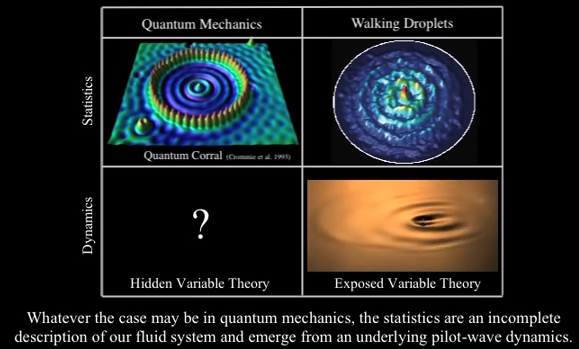
I start with a screen grab from the video below. Yves Couder and friends are clearly looking at hidden variable theories:

Screen Shot 2014-03-10 at 8.40.20 AM

Screen Shot 2014-03-09 at 6.46.17 PM

Here is a 3 minute movie with the above slide:

The pilot-wave dynamics of walking droplets

Here is a paper about eigenstates, etc… Self-organization into quantized eigenstates of a classical wave driven particle  (Stéphane Perrard1, Matthieu Labousse, Marc Miskin, Emmanuel Fort, and Yves Couder).

Compare that with my hastily written post.

See also (pointed out by  Warren Huelsnitz) :

 “Why bouncing droplets are a pretty good model of quantum mechanics

Yves Couder . Explains Wave/Particle Duality via Silicon Drop

“Couder could not believe what he was seeing”.

Here it was sort of a eureka moment at home on a Sunday afternoon.

Here is a link to the whole show.(45 mins)

https://www.youtube.com/watch?v=KByhu3HKy5s

Valentini:

Valentini (along with me) thinks that QM is wrong, in that its not the ‘final layer’. His de Broglie arguments are powerful and hit close to home for me. I have read most of David Bohm’s papers and books since discovering him as a 4th year undergrad back in the 80s. Bohm’s ideas launched mine. Note that much of physics is built on the assumption that with QM somehow ‘this time its different’ – that any future theory will need to be QM compliant or it is wrong. As if QM was somehow as certain as the (mathematical and hence solid) 2nd Law or something. This leaves no room for argument or dissent. Perfect conditions for a paradigm change!

http://www.perimeterinstitute.ca/search/node/valentini

EG:

This is the presentation that outlines things as he sees them. I see things that way too, although I am of the opinion that the pilot waves are GR ripples.

http://streamer.perimeterinstitute.ca/Flash/3f521d41-f0a9-4e47-a8c7-e1fd3a4c63c8/viewer.html

Is Quantum Mechanics Tried, True, wildly Successful, and Wrong?

Quantum Theory at the Crossroads
Reconsidering the 1927 Solvay Conference

A relaxing read:

Not even wrong. Why does nobody like pilot-wave theory?

“De Broglie’s law of motion for particles is very simple. At any time, the momentum is perpendicular to the wave crests (or lines of constant phase), and is proportionally larger if the wave crests are closer together. Mathematically, the momentum of a particle is given by the gradient (with respect to that particle’s co-ordinates) of the phase of the total wavefunction. This is a law of motion for velocity, quite unlike Newton’s law of motion for acceleration. “

Antony Valentini, Beyond the Quantum

If QM runs as wiggles in GR, we have a possible way to get collapse, and have a linear QM theory that breaks down over long times or with too many signals in one place.

In other words:

Each QM state vector is represented NOT only as a vector in a Hibert Space, but are really ‘real’  arrangements of (usually small scale) GR waves.

Since GR waves behave linearly over a large range of frequencies and amplitudes, these waves do not interact, and can be represented well as they are now in QM – by a Hilbert Space.

Collapse occurs when this linearity is compromised.

Thus there is a limit to entanglement and Quantum computing. The collapse of the wave function is a physical happening independent of observers. It occurs when these waves self – interact.

Indeed – with a theory where the QM states can only interact in a linear fashion, we have absurdities such as infinite computing power combined with massive Hilbert Spaces.

This should be quantifiable. In other words the collapse can be simulated on a computer system without Bohr like handwaving or the Many World’s trillions of universes per second per cubic cm coming into existence to avoid a true collapse (ok I know its more than trillions per second…).

To estimate the conditions for collapse: Take the likely amplitude of a single quantum wave (by looking at this mass – difference theory that I have for instance) and then see how many can pile into the same place before non-linear interference occurs – which would start a collapse. So collapse occurs when a simple isolated system interferes with a system with many more moving parts – an observation.

Entanglement/EPR/Bell outside the light cone is handled by non-local topology “worm – holes” in GR.

-Tom

How is that even a question?

Previous posts have all not mentioned quantum effects at all. That’s the point – we are building physics from General Relativity, so QM must be a consequence of the theory, right?

Here are some thoughts:

QM seems to not like even special relativity much at all. It is a Newtonian world view theory that has been modified to work in special relativity for the most part, and in General Relativity not at all.

There are obvious holes in QM – the most glaring of which is the perfect linearity and infinitely expandable wave function. Steven Weinberg has posted a paper about a class of QM theories that solve this problem. In essence, the solution is to say that the state vector degrades over time, so that hugely complex, timeless state vectors actually self collapse due to some mechanism. (Please read his version for his views, as my comment are from my point of view.)

If one were to look for a more physical model of QM, something along the lines of Bohm’s hidden variables, then what would we need:

Some sort of varying field that supplies ‘randomness’:

  • This is courtesy of the monopole field discussed in previous posts about the proton and the electron.

Some sort of  reason for the electron to not spiral into the proton:

  • Think De Broglie waves –  a ‘macroscopic’ (in comparison to the monopole field) wave interaction. still these waves ‘matter waves’ are closely tied to the waves that control the electromagnetic field.
  • Put another way – there is room for many forces in the GR framework, since dissimilar forces ignore each other for the most part.
  • Another way of thinking about how you talk about multidimensional information waves (hilbert spaces of millions of dimensions for example), is to note that as long as there is a reasonable mechanism for keeping these information channels separate, then there is a way to do it all with a meta field – GR.

Quantum field theory:

  • This monopole field is calculable and finite, unlike the quantum field theories of today, which are off by a factor of 10100 when trying to calculate energy densities, etc.

History has showed us that all physical theories eventually fail. The failure is always a complete failure in terms of some abstract perfectionist viewpoint, but in reality, the failure only amounts to small corrections. Take for instance gravity. Newton’s theory is absurd – gravity travels instantly, etc. But it is also simple and powerful, it predictions working well enough to put people on the Moon.

Quantum Mechanics, it would seem, has a lot of physicists claiming that ‘this time is different’ – that QM is ‘right’. Nature does play dice. There are certain details of it yet to be worked out, like how to apply it to fully generalized curvy spacetimes, etc.

Lets look at what would happen if it were wrong. Or rather, lets look at one way that it could be wrong.

QM predicts that there are chances for every event happening. I mean in the following way – there is a certain probability for an electron (say) to penetrate some sort of barrier (quantum tunneling). As the barrier is made higher and or wider, the probability of tunneling goes down according to a well defined formula: (see for example this wikipedia article). Now, the formulas for the tunneling probability do not ‘top out’ – there is a really, really tiny chance that even a slowly moving electron could make it through a concrete wall. What if this is wrong? What if there is a limit as to the size of the barrier? Or put another way – what if there is a limit to probability? Another way to look at this is to say that there is a upper limit on the half life of a compound. Of course, just as Newton’s theory holds extremely well for most physics, it may be hard to notice that there is not an unlimited amount of ‘quantum wiggle’ to ‘push’ particles through extremely high barriers.

Steven Weinberg has posted a paper about a class of theories that try to solve the measurement problem in QM by having QM fail. (It fails a little at a time, so we need big messy physics to have the wave collapse). I agree fully with his idea – that we have to modify QM to solve the measurement problem.