Archives For November 30, 1999

Posts that can go on the front page.

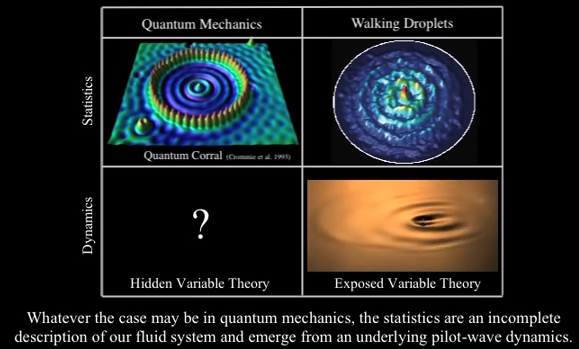
I start with a screen grab from the video below. Yves Couder and friends are clearly looking at hidden variable theories:

Screen Shot 2014-03-10 at 8.40.20 AM

Screen Shot 2014-03-09 at 6.46.17 PM

Here is a 3 minute movie with the above slide:

The pilot-wave dynamics of walking droplets

Here is a paper about eigenstates, etc… Self-organization into quantized eigenstates of a classical wave driven particle  (Stéphane Perrard1, Matthieu Labousse, Marc Miskin, Emmanuel Fort, and Yves Couder).

Compare that with my hastily written post.

See also (pointed out by  Warren Huelsnitz) :

 “Why bouncing droplets are a pretty good model of quantum mechanics

Yves Couder . Explains Wave/Particle Duality via Silicon Drop

“Couder could not believe what he was seeing”.

Here it was sort of a eureka moment at home on a Sunday afternoon.

Here is a link to the whole show.(45 mins)

https://www.youtube.com/watch?v=KByhu3HKy5s

Valentini:

Valentini (along with me) thinks that QM is wrong, in that its not the ‘final layer’. His de Broglie arguments are powerful and hit close to home for me. I have read most of David Bohm’s papers and books since discovering him as a 4th year undergrad back in the 80s. Bohm’s ideas launched mine. Note that much of physics is built on the assumption that with QM somehow ‘this time its different’ – that any future theory will need to be QM compliant or it is wrong. As if QM was somehow as certain as the (mathematical and hence solid) 2nd Law or something. This leaves no room for argument or dissent. Perfect conditions for a paradigm change!

http://www.perimeterinstitute.ca/search/node/valentini

EG:

This is the presentation that outlines things as he sees them. I see things that way too, although I am of the opinion that the pilot waves are GR ripples.

http://streamer.perimeterinstitute.ca/Flash/3f521d41-f0a9-4e47-a8c7-e1fd3a4c63c8/viewer.html

Is Quantum Mechanics Tried, True, wildly Successful, and Wrong?

Quantum Theory at the Crossroads
Reconsidering the 1927 Solvay Conference

A relaxing read:

Not even wrong. Why does nobody like pilot-wave theory?

“De Broglie’s law of motion for particles is very simple. At any time, the momentum is perpendicular to the wave crests (or lines of constant phase), and is proportionally larger if the wave crests are closer together. Mathematically, the momentum of a particle is given by the gradient (with respect to that particle’s co-ordinates) of the phase of the total wavefunction. This is a law of motion for velocity, quite unlike Newton’s law of motion for acceleration. “

Antony Valentini, Beyond the Quantum

Can’t be done, it would seem, since gravity is spin 2.

Well, electromagnetism is spin 1, but we have tech gadgets and a billion transistors on one chip.

So can one construct a machine that behaves like a dipole?

Take a canonical dipole. Two radio antennas, both vertical, one transmitting, the other receiving. The question then is, can we make a mass (or more likely a Rube Goldberg system of masses) bob up and down by the action of another mass-system moving at some distance away? if we can, then we have constructed a ‘spin one’ field from gravity, in much the same way that one can build something that is more than its parts.

The underlying field would of course be spin 2, but the field interpreted from the motions of our mass systems would look like a covariant, fully geometric compliant spin 1 field. It would in fact be a spin 1 covariant field.

Contraptions and questions come to mind right away. How do normal gravitational waves radiate as the eccentricity of an orbit approaches 1? What about a similar structure but with say a small particle orbiting a slender rod along the long axis. Not looking for stable orbits here at all. Just a mechanism to transfer a dipole motion across empty space to another construction of masses.

It seems more than possible that such an arrangement exists.


I read this paper today like a breath of air.

What if the electron is not a single negative charge, but rather an onion

like arrangement of charge, with an excess of 1 unit negative?

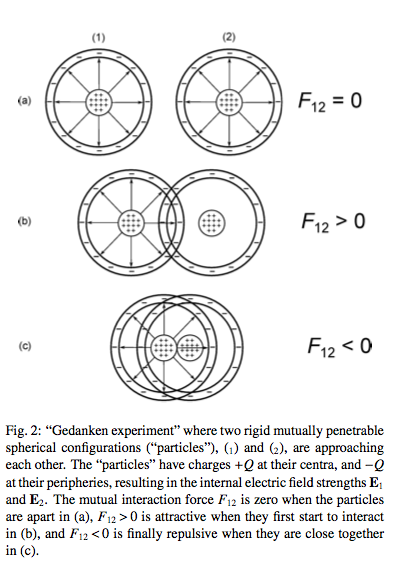
From Intrinsic Charges and the Strong Force by Bo Lehnert

Same for the neutron and proton (instead of 1/3 charged quarks).

Have a look at the image on the right. We see a ‘strong’ force holding these particles apart.

Could this be an actual model for real particles? I don’t think that the author of the paper intends for this model to be taken literally, but it certainly has some obviously interesting properties. Intrinsic Charges and the Strong Force.


How is that even a question?

Previous posts have all not mentioned quantum effects at all. That’s the point – we are building physics from General Relativity, so QM must be a consequence of the theory, right?

Here are some thoughts:

QM seems to not like even special relativity much at all. It is a Newtonian world view theory that has been modified to work in special relativity for the most part, and in General Relativity not at all.

There are obvious holes in QM – the most glaring of which is the perfect linearity and infinitely expandable wave function. Steven Weinberg has posted a paper about a class of QM theories that solve this problem. In essence, the solution is to say that the state vector degrades over time, so that hugely complex, timeless state vectors actually self collapse due to some mechanism. (Please read his version for his views, as my comment are from my point of view.)

If one were to look for a more physical model of QM, something along the lines of Bohm’s hidden variables, then what would we need:

Some sort of varying field that supplies ‘randomness’:

  • This is courtesy of the monopole field discussed in previous posts about the proton and the electron.

Some sort of  reason for the electron to not spiral into the proton:

  • Think De Broglie waves –  a ‘macroscopic’ (in comparison to the monopole field) wave interaction. still these waves ‘matter waves’ are closely tied to the waves that control the electromagnetic field.
  • Put another way – there is room for many forces in the GR framework, since dissimilar forces ignore each other for the most part.
  • Another way of thinking about how you talk about multidimensional information waves (hilbert spaces of millions of dimensions for example), is to note that as long as there is a reasonable mechanism for keeping these information channels separate, then there is a way to do it all with a meta field – GR.

Quantum field theory:

  • This monopole field is calculable and finite, unlike the quantum field theories of today, which are off by a factor of 10100 when trying to calculate energy densities, etc.

Re: http://en.wikipedia.org/wiki/Woodward_effect

Now I’m not sure that he is onto something real or not, although experiments are still being performed which detail positive results.

He does have some pretty convincing arguments about what happens to an object with a varying mass:

Let us suppose that, viewed in our inertial frame of reference moving with respect to the brick, when the mass of the brick changes, its velocity changes too so that its momentum remains unchanged. (The cause of the velocity change is mysterious. After all, driving a power fluctuation in the brick to excite a mass fluctuation need not itself exert any net force on the brick. But we’ll let that pass.) We see the brick accelerate. Now we ask what we see when we are located in the rest frame of the brick. The mass fluctuates, but in this frame the brick doesn’t accelerate since its momentum was initially, and remains, zero. This, by the principle of relativity, is physically impossible. If the brick is observed to accelerate in any inertial frame of reference, then it must accelerate in all inertial frames. We thus conclude that mass fluctuations result in violations of local momentum conservation if the principle of relativity is right.

Of course no ‘real’ physicist thinks that you can change the mass of something without a pipe of energy or mass leading into it, but that’s what he means here – some ‘magical’ varying mass. I assume that for my electron model, this varying mass is only a local effect – there is a secret topological ‘wormhole’ pipe that connects two electrons together, so the total mass is constant.

So does Woodwards insight give us any guidance with the effects of the resulting monopole gravitational waves on other varying masses? We can see right away that momentum conservation for such a topological system is only adhered to over a time average.

Look at the diagram from Woodwards article:

http://physics.fullerton.edu/~jimw/nasa-pap/

We see shades of my varying mass model. I am not saying that electrons can self accelerate, but more that the interaction of varying mass objects leads to entirely new physics, without introducing any new equations.

With monopole gravitational waves, the electron will feel a varying force, and the averaged momentum rule from Woodward would then imply that the net average acceleration on the particle is in one direction only, depending on the phase of the arriving wave. Of course these phases are what are called charge – the electron wants to maximize the acceleration, in order to go down the potential energy landscape in the best direction.

I will show with a few simple equations how it could be that electrons and electromagnetic theory can be constructed from GR alone.

1) The electron is some sort of GR knot, wormhole or other ‘thing’, which has one property – its mass is moving from 0 to 2*me in a wave pattern. Well actually, the mass does not have to all b oscillating, it only changes the math slightly.

2) Due to the birkhoff theorem, the gravitational potential at any time is given by the amount of mass inside a certain radius.

3) Due to 2) above, we can use the simple gravitational formula to describe the potential.

\Phi(r,t)=2\frac{m_eG}{r}sin(\omega t)

This potential exerts a force that depends on the frequency of the varying mass, taking the derivative to get the slope of the potential holding r steady:

\frac{\partial}{\partial t}\Phi(r,t)=2\omega\frac{m_eG}{r}cos(\omega t)

With the mass changing, we have monopole graviational waves emanating (and incoming, since the universe is not empty), from such a structure.

The big assumption here is of course the varying mass of the electron. Where does the mass go? The obvious answer is through some sort of wormhole, so perhaps there is another electron somewhere else with the opposite phase of mass. Shades of the Pauli exclusion principle.

There are lots of places on the internet where one can find electron models where the the electron is modeled on some standing wave, which is what this really amounts to, since electrons would have a huge force on them if the incoming and outgoing are not balanced.

History has showed us that all physical theories eventually fail. The failure is always a complete failure in terms of some abstract perfectionist viewpoint, but in reality, the failure only amounts to small corrections. Take for instance gravity. Newton’s theory is absurd – gravity travels instantly, etc. But it is also simple and powerful, it predictions working well enough to put people on the Moon.

Quantum Mechanics, it would seem, has a lot of physicists claiming that ‘this time is different’ – that QM is ‘right’. Nature does play dice. There are certain details of it yet to be worked out, like how to apply it to fully generalized curvy spacetimes, etc.

Lets look at what would happen if it were wrong. Or rather, lets look at one way that it could be wrong.

QM predicts that there are chances for every event happening. I mean in the following way – there is a certain probability for an electron (say) to penetrate some sort of barrier (quantum tunneling). As the barrier is made higher and or wider, the probability of tunneling goes down according to a well defined formula: (see for example this wikipedia article). Now, the formulas for the tunneling probability do not ‘top out’ – there is a really, really tiny chance that even a slowly moving electron could make it through a concrete wall. What if this is wrong? What if there is a limit as to the size of the barrier? Or put another way – what if there is a limit to probability? Another way to look at this is to say that there is a upper limit on the half life of a compound. Of course, just as Newton’s theory holds extremely well for most physics, it may be hard to notice that there is not an unlimited amount of ‘quantum wiggle’ to ‘push’ particles through extremely high barriers.

Steven Weinberg has posted a paper about a class of theories that try to solve the measurement problem in QM by having QM fail. (It fails a little at a time, so we need big messy physics to have the wave collapse). I agree fully with his idea – that we have to modify QM to solve the measurement problem.

According to the accepted theories of physics, this question is not in good taste. An electron is described by charge, mass, and a few other parameters. But there are no ‘whys’. Why do electrons have a charge of 1? or a mass of 0.511 MeV? No one knows. Most physicists will not think or worry about this.

There are lots of theories about electron substructure out there. Here is mine.

The electron is a knot, pattern, or whirligig built of ‘standard general relativity’.

How could this possibly work? I really don’t have all the answers – or even all the questions yet, but there are some details that I want to share.

Basically, an electron is a construction of GR, where (here is the leap of faith part) the mass of the electron varies in an even sine wave cycle at an enormous frequency – 10^60 Hz or so. This ‘varying mass’ creates monopole gravitational radiation. The net effect is that there are forces between neighbouring electrons that scale in strength with the frequency of this pulsating mass.

Example Detail
So how could something like charge be generated by classical general relativity? Gravity is 10^42 or some factor like that weaker than the electrostatic force. It turns out to be not all that hard to accomplish, at least in broad strokes. Basically the frequency of the varying mass creates via the slope of the gravitational potential, a net force on any neighbouring similar structure that also has a varying mass.

General Thesis?

First this: General Relativity alone is sufficient to create a pretty complex interacting world of ‘stuff’. I guess almost anyone would agree with this statement, as a fictional universe built of rotating, coalescing black holes has plenty of interaction, energy exchange, and other qualities. But it is not this world.

My theory, however strange it may sound is exactly that -we are living in a world described only by GR. All the interactions, fields, quantum phenomena and the rest can ultimately be described via plain old General Relativity. Plain except for the massively interconnected topology.

This is not an ‘end of physics’ argument, for if my theory is ‘true’ all I think it means is that we have found a new problem set – GR is not easily solvable, linear or predictable. In other words, a GR – only universe can be ‘almost anything’ according to the math – it may mean that new theories as important and different from the ‘base GR’ will be needed. Example: Cartesian – Newtonian space is the base for theories such as Newtonian Gravity, thermodynamics, etc. Common belief is that these theories are constructed using a Euclidian coordinate system as only a ‘part’ of the theory – it is my belief that, for instance, Newton’s Gravity does not so much use cartesian coordinates, as it is cartesian theory.